• Published on

    THE REVEALER

    Woman praying and ethereal word,

    Holy Spirit reveals. God fulfills.

    All of it was happening beneath the surface — the wind, the earthquake, the fire, the whisper — weaving together a story I didn’t yet know I was living… before I ever wrote anything down… before I understood patterns… before I knew God was preparing me for anything at all… there was simply an awakening. It didn’t happen all at once. It came in pieces — moments I didn’t recognize at the time, but that I can see clearly now.


    In August of 2018, a severe storm swept through our area in Massachusetts. That storm marked the beginning of something shifting inside me, long before I had language for it. Read more about how it all started here.


    And then came the fires — the devastating Paradise, California fire in late 2018. I remember the weight of it, the sorrow of it. I didn’t yet see how these events were forming a pattern, but they were part of the same stirring. Read more about it in "LOCUST."


    In 2019, the Holy Spirit said, "The Demons are Out." It wasn't until a year later that I understood what it meant and wrote about it. It was another moment I carried quietly, without understanding. Read more about it in "The Demons are Out."


    Wind. Fire. Earthquake.


    And after all of that… came something quieter. Something gentler. Something that reached me in a way the storms never could: A still small voice. 1 Kings 19:11-13. That was the moment everything changed — the moment God awakened me fully. I didn’t know what He would say next. I didn’t know what it would mean for my life. I only knew that He had my attention.


    This is where my story begins.


    I never expected to be anything. I didn’t ask for a title. But once I began praying in tongues, only God knows what was being prayed for.


    1 Corinthians 14:2 "For he that speaketh in an unknown tongue speaketh not unto men, but unto God: for no man understandeth him; howbeit in the spirit he speaketh mysteries."


    What I do know is at that time Holy Spirit began to move in ways I couldn’t ignore. Sometimes quietly, sometimes loudly, and often with visions and words that pressed on my heart until they were written down.


    Around 2020, the Holy Spirit made one thing clear: you are a“revealer.” It wasn’t explained. It wasn’t dramatic. It was simply given. I had never heard of a gift of the Spirit called "revealer." I researched the gifts again and could not find any gift called "revealer." I told my husband about the word, tucked it away and didn’t pursue it.


    That same year, in December 2020, I felt led to write a Facebook post about Roe v. Wade being overturned. I didn’t understand it. I didn’t have a timeline. I only knew I was supposed to write it and leave it alone. So I did.


    Then, sometime in 2022, our fairly new — and first in 20 years of marriage — pastor preached a message on gifts. In the middle of that sermon, he used the word “revealer.” Hearing that word spoken publicly after the Holy Spirit had already whispered it to me privately stopped me in my tracks. “Flabbergasted” is the right word. It was like God quietly underlined what He had already said.


    Later that same year, in 2022, the Supreme Court overturned Roe v. Wade. The post I had written back in December 2020 suddenly had context. I hadn’t understood it when I wrote it — I just obeyed. The meaning unfolded in God’s timing, not mine.


    That’s when the word “revealer” began to make sense. Not as a title I claimed, but as a description of what had been happening all along. The Holy Spirit reveals: Sometimes it’s a whisper, sometimes a vision, sometimes a word that won’t leave until it’s written. The understanding comes later.


    A calling isn’t about status or office. It isn’t about being seen or being right. It’s about being obedient. It’s about listening. It’s about trusting that God knows what He’s doing, even when you don’t. All glory to God always!


    This testimony is given as encouragement for the Body of Christ: God still speaks. He still reveals. And He still uses ordinary people in quiet, unexpected ways to bring His purposes to light.


    May He guide your steps and light your path.

  • Published on

    ALREADY BUT NOT YET

    Image description

    Transformed by the Holy Spirit

    The Journey of Sanctification: Walking with the Holy Spirit in an Imperfect World


    Dear brothers and sisters in Christ: Grace and peace to you from our Lord Jesus Christ.


    In the quiet moments of reflection, as we meditate on the boundless mercy of God, we are drawn into the profound mystery of the Holy Spirit's work within us. Today, I invite you to journey with me through the sacred pages of Scripture, exploring how the indwelling of the Holy Spirit transforms our lives—not as an instantaneous eradication of our sinful nature, but as a gentle, ongoing process of growth, refinement, and reliance on divine grace.


    Let us approach this with reverence, for we speak of the third Person of the Trinity, the Comforter promised by our Savior, who guides us toward holiness amid our human frailty.


    Beloved, when we come with faith in Jesus Christ, repenting of our sins and believing in His atoning work on the cross, we receive the Holy Spirit as a divine pledge. As it is written in Acts 2:38: "Then Peter said unto them, Repent, and be baptized every one of you in the name of Jesus Christ for the remission of sins, and ye shall receive the gift of the Holy Ghost." This reception is echoed in Ephesians 1:13-14: "In whom ye also trusted, after that ye heard the word of truth, the gospel of your salvation: in whom also after that ye believed, ye were sealed with that holy Spirit of promise, Which is the earnest of our inheritance until the redemption of the purchased possession, unto the praise of his glory."


    Oh, what a wondrous assurance! The Holy Spirit seals us as God's own, marking us for eternal redemption. Yet, in His infinite wisdom, God does not render us instantly incapable of sin upon this sealing. Instead, He begins a sacred process within us, where the Spirit takes residence in our very beings. As 1 Corinthians 6:19 declares: "What? know ye not that your body is the temple of the Holy Ghost which is in you, which ye have of God, and ye are not your own?" We become living temples, but temples still under construction, prone to the dust of this fallen world.


    Let us delve deeper into this divine process, known in theological terms as progressive sanctification. It is not a sudden leap into sinless perfection but a lifelong pilgrimage, where the Holy Spirit labors tirelessly to conform us to the image of Christ. The Spirit empowers us to resist the temptations that once held us captive, producing in us the fruit of righteousness: "But the fruit of the Spirit is love, joy, peace, longsuffering, gentleness, goodness, faith, Meekness, temperance: against such there is no law" (Galatians 5:22-23).


    Through the Spirit's guidance, we are progressively sanctified—set apart for God's purposes. As 2 Thessalonians 2:13 reminds us: "But we are bound to give thanks alway to God for you, brethren beloved of the Lord, because God hath from the beginning chosen you to salvation through sanctification of the Spirit and belief of the truth." This sanctification is active and dynamic: The Spirit convicts us of sin (John 16:8), illuminates Scripture to our minds (John 14:26), and strengthens us in weakness (Romans 8:26).


    And behold the glorious promise that sustains us in this journey: 'But we all, with open face beholding as in a glass the glory of the Lord, are changed into the same image from glory to glory, even as by the Spirit of the Lord' (2 Corinthians 3:18). Yes, beloved—we are all being changed, degree by degree, from one measure of glory to another, as we gaze upon Christ. This transformation is the gentle, persistent work of the Holy Spirit, who takes the radiance of Jesus and reflects it ever more brightly in our lives.


    Yet, in God's sovereign design, we can still stumble, still yield to temptation if we do not walk in step with the Spirit. The Apostle Paul, that pillar of faith, lays bare his own struggles in Romans 7:14-25: "For we know that the law is spiritual: but I am carnal, sold under sin... For the good that I would I do not: but the evil which I would not, that I do... O wretched man that I am! who shall deliver me from the body of this death? I thank God through Jesus Christ our Lord." Here, Paul confesses the ongoing battle between the renewed spirit and the flesh—a battle that even the greatest saints wage until glory.


    Consider also the lives of two anointed kings of Israel, David and Solomon, whose stories illuminate this very truth. Both were greatly blessed by God—David, a man after God's own heart, empowered by the Spirit from his youth; Solomon, granted unparalleled wisdom and splendor. Yet both fell into grievous sin: David in adultery and murder, Solomon in idolatry, turning his heart to foreign gods through the influence of his many wives (1 Kings 11:4–8). Solomon's end was marked by divine displeasure—"Solomon did evil in the sight of the Lord, and went not fully after the Lord, as did David his father" (1 Kings 11:6)—with no record of repentance restoring his fellowship. David, however, when confronted, humbled himself profoundly: "I have sinned against the Lord" (2 Samuel 12:13), pouring out his soul in Psalm 51 with a broken and contrite heart that God never despises. Throughout his life, David returned again and again to repentance, dying in covenant favor. Thus, even the most Spirit-blessed among us remain vulnerable to sin, but the path of progressive sanctification—of growing from glory to glory—is marked by ongoing humility and repentance, keeping our hearts soft toward the God who ever calls us back to Himself.


    And so, dear reader, receiving the Holy Spirit does not prohibit us from sinning; rather, it equips us for victory while acknowledging our need for continual repentance. As 1 John 1:8-10 solemnly warns believers: "If we say that we have no sin, we deceive ourselves, and the truth is not in us. If we confess our sins, he is faithful and just to forgive us our sins, and to cleanse us from all unrighteousness. If we say that we have not sinned, we make him a liar, and his word is not in us." What grace! In our failings, we find not condemnation but an invitation to draw nearer to the throne of mercy.


    In the midst of this process, Scripture points us toward a glorious horizon. Consider 1 Corinthians 13:10: "But when that which is perfect is come, then that which is in part shall be done away." Paul, writing to the church at Corinth amid discussions of spiritual gifts and love, contrasts our current partial knowledge with the fullness to come. "That which is perfect" (from the Greek to teleion, signifying completeness or maturity) is often understood as the return of Christ or our entrance into eternity, when we shall see Him "face to face" and "know even as also I am known" (1 Corinthians 13:12).


    This perfection is not the eradication of sin in this life but the ultimate glorification awaiting believers. As Philippians 3:12-14 exhorts: "Not as though I had already attained, either were already perfect: but I follow after, if that I may apprehend that for which also I am apprehended of Christ Jesus... I press toward the mark for the prize of the high calling of God in Christ Jesus."


    Until then, we live in the tension of the "already but not yet"—sanctified positionally through Christ's blood, yet progressing practically through the Spirit's work.


    Paul culminates his discourse with a triumphant declaration in 1 Corinthians 13:13: "And now abideth faith, hope, charity, these three; but the greatest of these is charity." In our imperfect state, these virtues endure as anchors for the soul. Faith trusts in God's promises amid uncertainty; hope anticipates the fulfillment of His kingdom through Christ Jesus; and charity— that divine, selfless love (agapē)—binds them all through the Holy Spirit's work in a believer's heart, reflecting God's very nature (1 John 4:8).


    Love is supreme because it outlasts even faith and hope in eternity. When we behold Christ, faith becomes sight, and hope is realized. But love? It flows eternally from the heart of God. In our daily walk, this love empowers us to forgive, to serve, and to overcome sin's pull, all through the Holy Spirit's enabling.


    As we conclude this reflection, let us bow in awe before the Living God, the God of the living. The Holy Spirit's work in us is a profound mystery—a process of transformation that honors our free will while drawing us inexorably toward holiness. We can still sin, yes, but we are no longer slaves to it (Romans 6:14: "For sin shall not have dominion over you: for ye are not under the law, but under grace"). Walk in the Spirit, confess your failings, and press on toward "the prize of the high calling of God in Christ Jesus."


    May the Lord bless you and keep you, illuminating your path with His Word. Until we meet in that perfect realm, let us abide in faith, hope, and charity, and the greatest which is charity [love].


    In Christ's love,

    A Humble Seeker

  • Published on

    THE WORD MADE FLESH

    Image description

    "That was the true light which lighteth every man that cometh into the world." John 1:9

    Originally posted October 11, 2025. Reposted November 24, 2025, with no changes made.

    In the beginning God created the heaven and the earth. And the earth was without form, and void; and darkness was upon the face of the deep. And the Spirit of God moved upon the waters. (Genesis 1:1-2, KJV)


    These words launch the sacred narrative, revealing God's eternal act in perfect harmony—one God eternally existing as Father, Son, and Holy Spirit: the Father decreeing, the Spirit hovering in life-giving power, and the Word (the Son) executing light into being. "And God said, Let there be light: and there was light" (Genesis 1:3). This divine utterance pierces chaos, symbolizing order, holiness, and life. The Word is no created being but God Himself, co-eternal and co-equal with the Father and Spirit, sharing one divine essence in perfect unity—distinct Persons, inseparable in nature, will, and work. As we shall see, Jesus—the Word made flesh—cannot be created, for He is the One by whom all things were made. "All things were made by him; and without him was not anything made that was made" (John 1:3). This truth echoes through the apostles' writings, culminating in Revelation's eternal light, where God and the Lamb illuminate forever.


    In this blog, we will trace Scripture's golden thread: from primordial light to apostolic affirmations in John and Colossians, bolstered by the three who bear witness to Christ's deity. We will affirm His eternal nature—self-existent and divine—countering any notion of origination. For only the eternal can precede and sustain creation, as "He is before all things, and by him all things consist" (reside in) (Colossians 1:17). May this journey stir in you a glorious worship to the one true God: "O Lord, how manifold are thy works! in wisdom hast thou made them all" (Psalm 104:24).


    In the opening verses of Genesis, we behold a formless void shrouded in darkness, yet the Spirit of God moves upon the waters with gentle, omnipotent purpose—preparing the canvas for divine artistry and infusing it with the breath of life. This "moving" or hovering of the Spirit is a beautiful picture of God's caring presence. Then God said, "Let there be light," and light burst forth through the Word (Jesus Christ), not merely physical illumination but a profound symbol of God's holiness dispelling shadows, deception, and chaos. This light foreshadows the ultimate redemption, where "the people that walked in darkness have seen a great light" (Isaiah 9:2), pointing directly to Christ.


    The psalmist bridges this creation moment to the New Testament revelation: "By the word of the Lord were the heavens made; and all the host of them by the breath of his mouth" (Psalm 33:6), harmonizing the Father's decree, the Word's execution, and the Spirit's breath as one God in action. John's Gospel unveils the mystery further: "In the beginning was the Word, and the Word was with God, and the Word was God. The same was in the beginning with God" (John 1:1-2). Here, the Logos—God's divine reason and expression—is not a later creation but eternally existent, distinct in person yet one in essence with the Father. Amid debates over exact phrasing, the core truth shines: This Word is Jesus incarnate (John 1:14), declaring His timeless deity when He says, "Before Abraham was, I am" (John 8:58), echoing God's eternal name in Exodus 3:14. The prophet Micah affirms the Messiah's origins: "whose goings forth have been from of old, from everlasting" (Micah 5:2). In this Word dwells life itself, and that life is the light of men, radiating undimmed into the darkness (John 1:4-5)—Jesus, the eternal Word of God, through whom the Father created all things and brought everything into existence: "All things were made by him; and without him was not any thing made that was made" (John 1:3). He did not create Himself; He is God's Word, the uncreated Creator who holds all in being.


    Yet, so much debate and argument have swirled around the precise wording of John 1:1—"the Word was God" versus alternative renderings like "was a god"—often missing the forest for the trees in theological battles that have divided believers for centuries. God does not command us to win debates but to believe in His Son for eternal life (John 3:16: "Whosoever believeth in him should not perish"), and to spread this gospel to every creature. These ongoing debates deflect from the verse's heart and the verses that follow:


    John 1


    3 "All things were made by him; and without him was not any thing made that was made.


    In him was life; and the life was the light of men."


    Jesus is God's Word; God speaks, and the Word executes. "Let there be light."


    Central to this revelation is the irrefutable truth that Jesus cannot be created precisely because He is the Creator—a logical and scriptural absolute that places Him outside the realm of contingent beings. If He originated everything, He cannot originate from anything Himself, for creators inherently precede and transcend their works; self-creation is an impossibility, as "every house is builded by some man; but he that built all things is God" (Hebrews 3:4). John's proclamation drives this home: "All things were made by him; and without him was not any thing made that was made" (John 1:3). The emphatic double negative leaves no loophole—every star, soul, speck and atom owes its existence to Him, echoing the creative command in Genesis and excluding any possibility of His own making.


    This eternal status unfolds richly across Scripture. His pre-existence shines in John 1:1-2, where the Word simply "was" in the beginning, not "became" at a point in time, and in John 17:5, where He shares glory with the Father "before the world was," including His role as redeeming Lamb foreordained before the foundation (1 Peter 1:20: "Who verily was foreordained before the foundation of the world, but was manifest in these last times for you"). The child born in Bethlehem is called "The everlasting Father, The mighty God" (Isaiah 9:6), titles reserved for the eternal Yahweh. He forms all things directly, as in Colossians 1:16-17 ("by him were all things created... he is before all things"), Hebrews 1:2-3 (God made the worlds "by whom," upholding them by His power), and 1 Corinthians 8:6 ("by whom are all things"). His divine attributes include self-existent life, shared eternally with the Father: "the Father hath life in himself; so hath he given to the Son to have life in himself" (John 5-26)—not borrowed or started, but inherent like the Father's own endless existence. He is equal with God, "being in the form of God" without claiming something extra (Philippians 2:6), and holds "all the fulness of the Godhead bodily" (Colossians 2:9).


    He stands distinguished from all creatures: Angels worship Him rather than rival Him (Hebrews 1:5-6), and His Melchizedek-like priesthood knows "neither beginning of days, nor end of life" (Hebrews 7:3). Even Revelation 3:14's "beginning of the creation" means source or ruler (arche), as in Proverbs 8:22-23 where Wisdom (Christ) is "from everlasting." Explicit denials abound: "Before me there was no God formed" (Isaiah 43:10), and as the "only begotten Son" He declares the unseen God (John 1:18). Potential misreadings, like "firstborn" in Colossians 1:15, denote preeminence—not origination—as with David made "firstborn" as highest king (Psalm 89:27). Only the eternal can precede creation because contingent things (everything that depends on something else to exist, like all created matter and beings) require a cause and a starting point; God alone is independent, giving life without needing any (Acts 17:24-25). Jesus embodies this: "I am Alpha and Omega... the Almighty" (Revelation 1:8, 17-18), the eternal One who sustains all without beginning or end.


    The Apostle Paul's praises to God in Colossians harmonize perfectly with John 1:1-2, exalting the eternal Son amid false teachings that would diminish Him to a mere emissary or angel. "Who is the image of the invisible God, the firstborn of every creature: For by him were all things created, that are in heaven, and that are in earth, visible and invisible, whether they be thrones, or dominions, or principalities, or powers: all things were created by him, and for him: And he is before all things, and by him all things consist" (Colossians 1:15-18). Here, "firstborn" (prototokos) signifies preeminence and heirship, not creation—as God promised David, "I will make him my firstborn, higher than the kings of the earth" (Psalm 89:27)—for the verses immediately affirm He creates those very realms, standing before and sustaining them.


    The parallels with John reveal profound oneness: John's comprehensive "all things" expands in Colossians to include heavenly hierarchies and invisible powers (like angels and spiritual authorities), refuting any intermediary creators and asserting Christ's absolute dominion, as everything in the universe—seen or unseen—is made through Him alone. The agency is identical—"by him" as the instrumental cause, mirroring the Word through which God spoke in Genesis and Psalm 33:6. Yet Colossians adds depth: Creation is not only "by" Him but "for" Him, orienting all existence toward His glory, as He shared pre-world splendor with the Father (John 17:5). This sustenance—"by him all things consist"—portrays Him as the divine glue holding atoms and angels together, echoing Hebrews 1:3's "upholding all things by the word of his power." The fullness of deity dwells in Him (Colossians 1:19; 2:9), making separation impossible: If God creates alone yet through the Son (Isaiah 44:24), they are one essence, mutually indwelling (John 14:10: "I am in the Father, and the Father in me"). This unity counters heresies, affirming the Son's eternal role in planning (Father), executing (Son), and quickening (Spirit implied, as "the Spirit quickeneth" in John 6:63).


    The passage in 1 John 5:7-8 (KJV) beautifully complements the themes of divine unity and historical testimony, emphasizing how God's eternal truth is confirmed in time through Jesus's life and work. Even focusing on the earthly witnesses that appear in all manuscripts—the Spirit, the water, and the blood, these three agree in one—these elements provide strong evidence against early false teachings that tried to separate Jesus's divine and human natures (such as ideas that the spiritual "Christ" only temporarily descended on the man Jesus at baptism and left before the cross). Instead, they affirm the eternal Creator's full incarnation from start to finish: Jesus came "by water and blood" (1 John 5:6), not by water only. The Spirit, who testifies because "the Spirit is truth," is the Holy Spirit who hovered in creation and continues to bear witness in believers' hearts (Romans 8:16) and through events like the baptism. The water recalls that baptism where the Father's voice declared "This is my beloved Son" (Matthew 3:17), marking the beginning of His public ministry. The blood points to the crucifixion, where water and blood flowed from His side (John 19:34), symbolizing complete atonement and proving His real, physical death for sins (Hebrews 9:12). These historical markers unite to show Jesus as the eternal "way, the truth, and the life" (John 14:6), with direct affirmations like Thomas's cry, "My Lord and my God" (John 20:28), and the Father's address about Jesus: "Thy throne, O God, is for ever" (Hebrews 1:8).


    The declaration "God is light, and in him is no darkness at all" (1 John 1:5) finds perfect resonance in the Word as "the true Light, which lighteth every man that cometh into the world" (John 1:9)—a oneness of essence where the Father's purity radiates through the Son. Jesus affirms, "He that hath seen me hath seen the Father" (John 14:9), making His light the visible expression of the invisible God. This shared radiance first ordered creation's dawn by separating light from darkness (Genesis 1:3-4), establishing moral and spiritual order from the void. In redemption, it exposes sin by revealing truth and convicting hearts, as Jesus declares, "I am the light of the world: he that followeth me shall not walk in darkness, but shall have the light of life" (John 8:12), drawing sinners to repentance and freedom (John 3:19-21). Eternally, it overcomes all darkness without fail or fluctuation, for God is the "Father of lights, with whom is no variableness, neither shadow of turning" (James 1:17)—unchanging in His gifts of wisdom and salvation, ensuring victory over evil and the promise of a shadowless future (Revelation 21:25).


    What dawns in Genesis's spoken light reaches eternal fulfillment in Revelation, where the holy city needs no sun or moon, "for the glory of God did lighten it, and the Lamb is the light thereof" (Revelation 21:23; see also 22:5). Here, the eternal Word—once active in creation's beginning—tabernacles forever as the Lamb slain yet victorious, sharing the throne with the Father (Revelation 22:1). As Alpha and Omega, the Almighty who was dead and lives (Revelation 1:8, 17-18), He receives worship alongside the Ancient of Days, their oneness sealing history's arc. In this radiant kingdom, night vanishes, and the redeemed walk in His light, heirs of the eternal Creator who holds all together from everlasting to everlasting.


    As many as receive Him become children of God (John 1:12), transformed by the One who made and sustains us. In a world where good is seen as evil, and evil as good, let the light of Jesus illuminate your path and guide you to His living water. Worship the Lamb who is worthy to receive power, riches, wisdom, strength, honor, glory, and blessing (Revelation 5:12)—for in the beginning, through the middle of time, and to the endless ages, He is the great I AM, the unchanging God who became flesh and was crucified to pay for our sins. May your life reflect His Glory, walking as children of light until we see Him face to face. Amen.


  • Published on

    ONCE TRULY SAVED, ALWAYS SAVED

    Originally posted October 4, 2025. Reposted November 24, 2025, with no changes made.

    There is a truth that anchors like an unbreakable chain: once truly saved, always saved. It is the doctrine of eternal life, a divine promise whispered across the pages of Scripture, echoing God's unchanging heart. Yet, in the clamor of casual confessions and bumper-sticker theology, this pearl of grace often gets dragged through the mud. Too many voices spout "Once Saved, Always Saved" (OSAS) as if it is a spiritual hall pass, a wink at willful sin that says, "Go ahead, indulge—God's got the eraser." But oh, beloved reader, that is not the gospel's song. It is a tragic misunderstanding that cheapens the cross and mocks the resurrection. The Bible does not peddle eternal life as a sinner's loophole; it wields it as a sacred fire, igniting holy living in the redeemed soul.


    Let us pause here, in reverence, and let the Word unfold this mystery. For in its light, we see not a doctrine to debate, but a reality to live—a transformation that turns "I believe" into "I become."


    Picture a Father's hand, calloused from crafting galaxies yet tender as a lullaby, clasping yours in the storm. That is the essence of eternal life: not our fleeting hold on Him, but His eternal embrace of us. Jesus Himself declares it with the weight of eternity in John 10:28-29: "And I give unto them eternal life; and they shall never perish, neither shall any man pluck them out of my hand. My Father, which gave them me, is greater than all; and no man is able to pluck them out of my Father's hand." Here, salvation is not a probationary lease—it's an irrevocable deed, signed in the blood of the Lamb.


    Paul, that storm-tossed apostle, chimes in with a chorus of cosmic defiance in Romans 8:38-39: "For I am persuaded, that neither death, nor life, nor angels, nor principalities, nor powers, nor things present, nor things to come, Nor height, nor depth, nor any other creature, shall be able to separate us from the love of God, which is in Christ Jesus our Lord." No force—seen or unseen, felt or feared—can pry us loose. And why? Because salvation is God's present, permanent possession from the first whisper of faith. As the Savior promises in John 5:24, "Verily, verily, I say unto you, He that heareth my word, and believeth on him that sent me, hath everlasting life, and shall not come into condemnation; but is passed from death unto life." We have not just glimpsed the shore; we have landed there, the Holy Spirit our down payment on glory (Ephesians 1:13-14), a seal that whispers, "In whom ye also trusted, after that ye heard the word of truth, the gospel of your salvation: in whom also after that ye believed, ye were sealed with that holy Spirit of promise, Which is the earnest of our inheritance until the redemption of the purchased possession, unto the praise of his glory."


    This isn't presumption; it is the quiet confidence of Philippians 1:6: "Being confident of this very thing, that he which hath begun a good work in you will perform it until the day of Jesus Christ." God's gifts and His call are irrevocable (Romans 11:29). He doesn't dangle hope only to yank it away. Eternal security, then, is rooted in His faithfulness, not our faltering steps. It is the freedom to exhale, knowing the One who knit us in the womb will not abandon us in the wilderness.


    But here is where the misunderstanding unravels like a poorly knit sweater: true salvation does not leave us lounging in the shallows. It surges through us like a river of living water, reshaping desires and redirecting feet. "If ye love me, keep my commandments," Jesus says in John 14:15—not as a burdensome yoke, but as the natural pulse of a heart made alive. Genuine belief is not a head-nod in a crowded room; it is a root that drinks deeply, sprouting love that acts. As the Spirit stirs within, obedience flows unbidden, involuntary, like breath to the lungs. You don't think to love your neighbor; you just do, because the Spirit of God has taken hold. The Kingdom of God is literally inside you: "Neither shall they say, Lo here! or, lo there! for, behold, the kingdom of God is within you." Luke 17:21. The phrase "the kingdom of God is within you" signifies that the presence and reign of God is already present in the hearts of believers. This means that the kingdom of God is not just a future hope but a transformative reality that exists within each person. It emphasizes that God's kingdom is not confined to a physical location but is in the midst of us, influencing our thoughts, actions, and relationships with others. This concept is aided by Holy Spirit inside a believer, allowing the kingdom to manifest in their lives.


    Consider the Parable of the Pounds in Luke 19:11-27, that vivid imagery of stewardship Jesus weaves for expectant crowds. A nobleman entrusts his servants with silver—not to burden them, but to invite them into his ventures. The faithful do not sweat and strain; they invest, multiply, and return with abundance, their master's joy is their reward. The slothful one? He buries his pound in fear, clutching excuses like a shield. "Saying you believe is not enough," the parable thunders. Words without works are chaff in the wind: "Even so faith, if it hath not works, is dead, being alone." James 2:17. Yet those works? They are not the root of salvation—they are its radiant fruit, evidence of the Vine's life pulsing through the branch (John 15:5). "I am the vine, ye are the branches: He that abideth in me, and I in him, the same bringeth forth much fruit: for without me ye can do nothing," Jesus reminds us, but with Him? Fruit burgeons without fanfare, a quiet testimony to grace at work.


    This is the Holy Spirit's artistry: Galatians 5:22-23 unfurls the harvest—"But the fruit of the Spirit is love, joy, peace, longsuffering, gentleness, goodness, faith, Meekness, temperance: against such there is no law." These aren't virtues we manufacture in gritted-teeth resolve; they are the overflow of new birth, crowding out sin's stubborn weeds. As John writes with pastoral fire in 1 John 3:6-9, "Whosoever abideth in him sinneth not: whosoever sinneth hath not seen him, neither known him. Little children, let no man deceive you: he that doeth righteousness is righteous, even as he is righteous. He that committeth sin is of the devil; for the devil sinneth from the beginning. For this purpose the Son of God was manifested, that he might destroy the works of the devil. Whosoever is born of God doth not commit sin; for his seed remaineth in him: and he cannot sin, because he is born of God." The "seed" is the Spirit Himself, germinating righteousness that makes habitual rebellion not just undesirable, but impossible for the truly redeemed.


    Ah, but the tragedy lies in how this doctrine gets hijacked. "Once saved, always saved" becomes a mantra for the half-hearted, a sly justification for willful sin: "God forgives it all, so why fight?" It is as if grace were a fire insurance policy, letting you torch the house and stroll away unscathed. Beloved, the Scriptures roar against such folly.


    Paul, ever the surgeon of souls, slices through the lie in Romans 6:1-2: "What shall we say then? Shall we continue in sin, that grace may abound? God forbid. How shall we, that are dead to sin, live any longer therein?" We've been buried with Christ in baptism, raised to newness of life (Romans 6:4)—"Therefore we are buried with him by baptism into death: that like as Christ was raised up from the dead by the glory of the Father, even so we also should walk in newness of life"—sin's empire lies in ruins, its scepter shattered. To rebuild it brick by brick is to deny the resurrection's power.


    And Hebrews 10:26-27 lands like a thunderclap: "For if we sin wilfully after that we have received the knowledge of the truth, there remaineth no more sacrifice for sins, But a certain fearful looking for of judgment and fiery indignation, which shall devour the adversaries." This is not a whip for the weary saint; it is a spotlight on the impostor, the one who tastes truth but never swallows it whole (Hebrews 6:4-6). Those who spout OSAS while wallowing in unrepentant mud are not secured—they are self-deceived, mirrors fogged by illusion. "But be ye doers of the word, and not hearers only, deceiving your own selves." James 1:22. True eternal life does not breed complacency; it kindles vigilance, a holy hunger to run hard after the Lover of our souls, Jesus Christ.


    In the end, eternal life is not a static creed etched in stone; it is a living flame, flickering in the chest of every child of God. It liberates from fear's chains, freeing us to love boldly, obey joyfully, and bear fruit abundantly—not to earn our standing, but because we have entered it. The unfaithful servant in Luke's parable did not forfeit a prize he never pursued; he exposed a faith that was fiction. But you, dear reader—held in hands scarred for your sake— you are invited to the Master's table, pounds in hand, heart aflame.


    To become a true believer is to surrender all to the Savior who gave all for you. Confess with your mouth the Lord Jesus and believe in thine heart that God hath raised him from the dead, and thou shalt be saved (Romans 10:9). Repent, as Peter thundered at Pentecost, and be baptized every one of you in the name of Jesus Christ for the remission of sins, and ye shall receive the gift of the Holy Ghost (Acts 2:38). It is no mere ritual, but a dying to self and rising in Him—whosoever believeth in him should not perish but have everlasting life (John 3:16). Cry out for the fire of the Holy Spirit, that baptism of flame John foretold: He shall baptize you with the Holy Ghost, and with fire (Luke 3:16). Be filled with the Spirit and watch as zeal ignites your service—preaching the gospel, tending the broken, stewarding the pounds with hands now steady in His. This is no fleeting spark, but an eternal blaze that empowers you to serve Jesus not in your strength, but His, turning ordinary days into offerings of glory to God.


    Let this truth settle like dew on parched ground: God's got you, not because you are good, but because He is God. And in that grip, sin withers, love flourishes, and eternity dawns. What if today, you laid down the excuses and stepped into the river? What fruit might the Spirit coax from your surrender?


    Until next time, may the peace of Christ guard your heart, and His joy be your strength. Amen.


  • Published on

    MILK TO MEAT IN THE CHURCH


    ​"Now unto him that is able to do exceeding abundantly above all that we ask or think, according to the power that worketh in us," Ephesians 3:20


    From Milk to Meat: Growing in Christ’s Deeper Truths


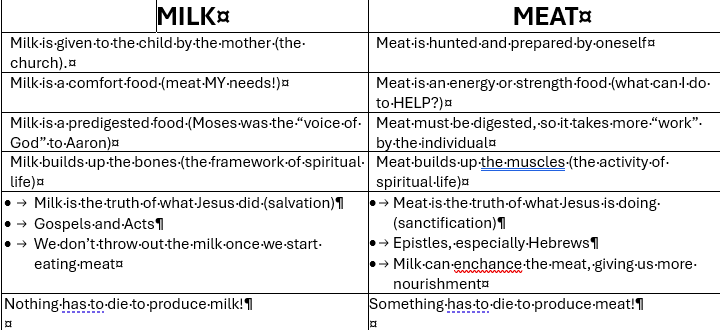
    Picture humanity’s journey with God as a vast tapestry, stretching across time, each thread woven with faith. The Bible tells us we are transformed from glory to glory, shaped into His image as our faith in Him grows. 2 Corinthians 3:18. In Old Testament days, a world of famine, drought, and enemies on every side, Israel's faith was shaky. They lacked the faith to produce even their most basic necessities. Deuteronomy 8:7-10; 1 Corinthians 3:2. Moses and Aaron, however, had meat-level faith in God, to liberate the Jews from Egyptian bondage. Faith that could actually provide the food, water and protection Israel needed in the wilderness. Noah had meat-level faith, and trusted God to save him through the Great Flood. Genesis 6:22. Abraham had meat-level faith when he raised his knife over his only son, Isaac, to sacrifice him as commanded when his faith was tested. That’s real “meat," a deeper faith. How many Christians can honestly understand that level of faith?


    "For when for the time ye ought to be teachers, ye have need that one teach you again which be the first principles of the oracles of God; and are become such as have need of milk, and not of strong meat. For every one that useth milk is unskilful in the word of righteousness: for he is a babe. But strong meat belongeth to them that are of full age, even those who by reason of use have their senses exercised to discern both good and evil." Hebrews 5:12-14


    “Milk” is the basic faith that leans on God for survival, like food, water and safety. The Israelites cried, "... for ye have brought us forth into this wilderness, to kill this whole assembly with hunger." Exodus 16:2-3. Their faith was stuck asking for basic necessities because they lacked basic necessities, and because they had no room for the greater faith available to them, as their hearts were full of need instead of faith in God. Abraham, Noah, Moses and others in the Old Testament had faith that moved mountains Matthew 17:20. In the New Testament, we see milk and meat in 1 Peter 2:2: “As newborn babes, desire the sincere milk of the word, that ye may grow thereby.” That you may grow thereby into meat-level faith and the power promised by Jesus. As Paul describes in Hebrews 5:14: “But strong meat belongeth to them that are of full age, even those who by reason of use have their senses exercised to discern both good and evil.”


    When Jesus came, He taught that obeying His commandments keeps us close to His love: John 15:10 “If ye keep my commandments, ye shall abide in my love." He opened up deeper truths about God’s kingdom, like the nearness of His rule: Matthew 4:17, “Repent: for the kingdom of heaven is at hand,” the power available to believers Mark 16:17-18, and the promise of eternal life John 3:16. Some receive milk for survival because their hearts cry out for it, like Israel in the desert pleading for bread: Exodus 16:3, “Would to God we had died… when we did eat bread to the full”. They had no room for more faith, because despair has crippled them. They failed to realize that God provides for His children who believe He does (faith). Matthew 6:31-32


    Others, like the apostles, received both milk and meat. Jesus told them not to worry about food or clothes but to trust God’s provision and power. Luke 22:35 “When I sent you without purse, and scrip, and shoes, lacked ye any thing? And they said, Nothing.” Still others live in abundance through faith, receiving also meat for power, because their hearts desire it: Philippians 4:19 “My God shall supply all your need according to his riches in glory by Christ Jesus." What we get depends on our faith, our needs, and God's Will, and we get what we deserve based on our faith. God knows our heart. Jeremiah 17:10 says, “I the Lord search the heart, I try the reins, even to give every man according to his ways, and according to the fruit of his doings.” The "fruit of his doings" are not voluntary actions; they are involuntary actions inspired in our heart by Holy Spirit, who guides us into all truth. John 16:13


    Jesus does not just save us and leave us at the starting line. He invites us into a life of authority and power. In Mark 16:17-18, He says, “In my name shall they cast out devils; they shall speak with new tongues; they shall lay hands on the sick, and they shall recover.” This kind of life takes faith, even just a tiny bit, like a mustard seed, that can move mountains. Stepping into Christ’s promised power is a process of seeking, desiring, meditating on God's Word and bringing into captivity even your thoughts to the obedience of Christ. For me, personally, it was, as I said, an involuntary and immediate knowledge, feeling, or understanding (hard to describe) of Christ's heart, and a yearning to be like Him. Not all see the same signs, because the Holy Spirit hands out gifts as God chooses. 1 Corinthians 12:11. But God does say, draw near to me and I will draw near to you. James 4:8. And, call on me and I will show you great and mighty things. Jeremiah 33:3. Have you called on God lately, to ask for greater faith, to ask for His Holy Spirit? Luke 11:13


    Think of milk as God keeping His people alive. Psalm 37:25 says, “Yet have I not seen the righteous forsaken, nor his seed begging bread.” That’s survival faith. Meat is different; it is about power. John 14:12 promises, “He that believeth on me, the works that I do shall he do also.. and EVEN GREATER.” Paul calls this meat, meant for those who have grown to discern right from wrong, good from evil. Hebrews 5:14.


    For over a hundred years, Pentecostals and Assemblies of God have held tight to this, living and breathing the power of Mark 16:17-18, and the gifts of Scripture, as the last denomination fully following the Bible’s call to this vast power promised by our Lord and Savior to all who believe!


    The Holy Spirit changes how we see God. Jesus promised He would send the Spirit to live inside of us forever. John 14:16-17. We see this at Pentecost where people spoke in tongues and preached with courage. Acts 2:4. Back in tough times, like Israel wandering in the desert for 40 years, people just wanted relief from the oppression of the wilderness, and lack of food and water. They cried out for bread and water. Numbers 11:13. The deeper faith Moses had in God's promises actually fed them with the manna in the morning and the quail at night. Moses' faith in God brought food from heaven and water from a rock. Exodus 16:4, 17:6


    Faith leads to abundance as promised:


    "But my God shall supply all your need according to his riches in glory by Christ Jesus." Philippians 4:19


    "But this I say, He which soweth sparingly shall reap also sparingly; and he which soweth bountifully shall reap also bountifully." 2 Corinthians 9:6


    "And God is able to make all grace abound toward you; that ye, always having all sufficiency in all things, may abound to every good work." 2 Corinthians 9:8


    "Now unto him that is able to do exceeding abundantly above all that we ask or think, according to the power that worketh in us." Ephesians 3:20


    "But seek ye first the kingdom of God, and his righteousness; and all these things shall be added unto you." Matthew 6:33


    These promises allow faith to grow beyond asking for basic necessities. As Jesus said, the Father knows what we need. When we realize this, we remove the boundary for faith to grow from milk at first, and then meat, or Spiritual Power, as promised by Jesus. Acts 1:8 says, “Ye shall receive power, after that the Holy Ghost is come upon you.” This meat faith knows God is close, guiding us like sons. Romans 8:14


    This journey is about lining up with God’s Will. Milk faith focuses on getting by, surviving. Israel begged, “What shall we eat?” Exodus 16:3. Moses trusted God to provide, saying, “Is the Lord’s hand waxed short?” Numbers 11:23. Meat faith knows God sees our needs before we ask. Matthew 6:8 says, “Your Father knoweth what things ye have need of, before ye ask him.” Obedience puts us in step with His purpose. Matthew 6:10. The Spirit molds us to please God. Philippians 2:13. Milk faith gets survival, as Matthew 6:31-33 promises, “Seek ye first the kingdom of God… and all these things shall be added unto you.” Meat faith steps into God's Power of discernment, as Scripture defines: "But strong meat belongeth to them that are of full age, even those who by reason of use have their senses exercised to discern both good and evil." Hebrews 5:14


    So how do we grow from milk to meat? It depends on our faith in God and what we need and want from Him. Milk faith is for beginners. Paul fed it to the Corinthians because they were stuck arguing and fighting. 1 Corinthians 3:1-3. It’s like Israel begging for bread Exodus 16:3, the simple trust that God will keep us alive. Peter puts it this way: “Desire the sincere milk of the word, that ye may grow thereby. 1 Peter 2:2. That is the starting point. Meat faith goes deeper, trusting God’s Will and power. Hebrews 6:1-6 says, “Let us go on unto perfection,” beyond the basics. In hard times, faith feeds the hungry: Psalm 37:19 says, “In the days of famine they shall be satisfied.” In good times, meat faith grabs hold of power and plenty: Acts 1:8 promises power, and 2 Corinthians 9:8 adds, “God is able to make all grace abound toward you.” Growth means trusting more, having more faith in God to do what He said He will do. If you think you are stuck, you stay stuck. If you believe God is bigger, you rise: Proverbs 23:7 “As he thinketh in his heart, so is he”.


    Some people say faith isn’t about moving from milk to meat. They might argue it is just trusting God, not chasing signs like Mark 16:17-18. Or they could say what we get from God depends more on our situation than our faith. They have a piece of the picture. The Spirit does give gifts differently. 1 Corinthians 12:4. God does meet our specific needs. Matthew 6:33. Israel’s lack of faith depended on Moses's meat faith. His meat faith worked miracles and fed them because he trusted God’s words. But Jesus connects trust in God to personal power. He says, “All power is given unto me." Matthew 28:18. He gives that power to us. Luke 10:19. He promises signs to those who believe. Mark 16:17-18. He even says we will do greater works than him. John 14:12. Paul pushes us to grow beyond milk. Hebrews 6:1. The Bible shows us that faith can reach higher, into meat, when we are ready. All we have to do is believe!


    Israel’s poor in spirit leaned on milk. Matthew 5:3. Noah and Abraham trusted God for meat. Since Jesus rose in 33 AD, God’s grace has poured out abundance over two millennia—think electricity, roads, tools, plenty and abundance—that have lifted our eyes from survival to power. The early church grabbed the power Jesus promised: Peter healed a lame man. Acts 3:6: “In the name of Jesus Christ… rise up and walk." Today, in 2025, some mock Mark 16:17-18, but God’s feast has always been available to all who believe. John 11:26. Milk keeps us alive in tough spots and lackadaisical times. Meat empowers us in plenty and zeal. Faith grows as we trust God's Plan and His Word. 


    Start with the word 1 Peter 2:2, have faith in God Hebrews 11:6, obedience to His Word John 15:10, and strive (pray) for His gifts Acts 1:8. Wherever we are, scarce or full, God gives us what our faith can hold.


    May He bless you and keep you always. Amen.


    ​(See also my other blogs on this subject: "The Sign of Jonah" and "Glory to Glory in Religion"

  • Published on

    A NEW HEART


    Heavenly Father, let all men turn from evil, seek God's righteousness, and believe in His Son, Jesus Christ. Amen.


    Recently, I had a discussion with someone on X.com (Twitter), who said that God must "regenerate" us, or give us a new heart, before we can believe in Jesus Christ as our Savior. He used 1 Corinthians 2:14 below to support his claim:


    "But the natural man receiveth not the things of the Spirit of God: for they are foolishness unto him: neither can he know them, because they are spiritually discerned."


    His supposition was that all men are "natural" men, born into sin, which is true: we are all sinners. Therefore, he said that we cannot see past our darkened hearts, to believe in and accept Jesus Christ as our Savior, unless God first regenerates our heart, or gives us a "new heart."


    When asked to quote scripture that says God first regenerates our heart before we can accept Jesus, he could not, but kept quoting the same scripture, 1 Corinthians 2:14, and debating his understanding of it. 


    First, is his understanding of 1 Corinthians 2:14 flawed?


    We should read 1 Corinthians 2, in its entirety, to understand the context of what Apostle Paul is talking about. Here, Paul is preaching to the sinners at Corinth, of which many confessed belief in Christ, but practiced all manner of immorality. They blindly followed the misguided men of Corinth, and believed that their behavior was normal and acceptable to the Lord.


    In verse 5, Paul tells them that their faith should not stand in the wisdom of men, but in the power of God. So, he is telling these sinners at Corinth that until they put their faith in God, instead of the world, they will remain "natural" men, unable to discern God's Word.


    The Bible further tells us that God wants ALL men to be saved, not just the ones He picks and chooses to give a "new heart": 


    "Who will have all men to be saved, and to come unto the knowledge of the truth.” 1 Timothy 2:4


    "For God so loved the world, that he gave his only begotten Son, that whosoever believeth in him should not perish, but have everlasting life." John 3:16


    All men. Whosoever believes.


    Now, the "knowledge of the truth" mentioned in 1 Timothy 2:4 above was promised by Jesus, after His death and resurrection, just before He ascended to the right hand of the Father in heaven. Jesus told His disciples that He would pray the Father to send the Comforter to guide believers  John 14:16-17. "The knowledge of the truth" comes from the Spirit of God (the Comforter, the Holy Spirit, the Holy Ghost, the Spirit of Truth, all one in the same Spirit of God):


    "Howbeit when he, the Spirit of truth, is come, he will guide you into all truth: for he shall not speak of himself; but whatsoever he shall hear, that shall he speak: and he will shew you things to come." John 16:13


    Although the twitter poster's understanding of 1 Corinthians 2:14 may be flawed, is it entirely inaccurate? The short answer is, Yes, it is entirely inaccurate. We can only receive the "knowledge of the truth," or God's Spirit, spoken of in 1 Timothy 2:4 above after accepting and believing in Jesus Christ, not before.


    Let's look at the specific scripture that tells us about man's new heart, Ezekiel 36:25-26:


    25 "Then will I sprinkle clean water upon you, and ye shall be clean: from all your filthiness, and from all your idols, will I cleanse you.


    26 A new heart also will I give you, and a new spirit will I put within you: and I will take away the stony heart out of your flesh, and I will give you an heart of flesh."


    We can see, when taking verses 25 and 26, in context, that God will indeed "regenerate," or give us a new heart, but not before sprinkling us with clean water. Jesus is the water of life referred to in Ezekiel 36:25:


    John 4


    13 "Jesus answered and said unto her, Whosoever drinketh of this water shall thirst again:


    14 But whosoever drinketh of the water that I shall give him shall never thirst; but the water that I shall give him shall be in him a well of water springing up into everlasting life."


    The key, however, to understanding 1 Corinthians 2:14 is knowing that we must first seek God's righteousness: “But seek ye first the kingdom of God, and his righteousness; and all these things shall be added unto you.” Matthew 6:33


    ​Seek God's righteousness. Be not conformed to the world, but be transformed by the renewing of your mind:


    Romans 12


    2 "And be not conformed to this world: but be ye transformed by the renewing of your mind, that ye may prove what is that good, and acceptable, and perfect, will of God.


    For I say, through the grace given unto me, to every man that is among you, not to think of himself more highly than he ought to think; but to think soberly, according as God hath dealt to every man the measure of faith."


    Draw close to God (seek God's goodness), and He will draw close to you:


    "Draw nigh to God, and he will draw nigh to you. Cleanse your hands, ye sinners; and purify your hearts, ye double minded." James 4:7


    Some men will never repent of the sin in their lives. Their hearts are dark and evil, and full of every abomination. The Light of Jesus, and the Word of God, hurts their eyes and ears. It offends them. It is foolishness to them. 1 Corinthians 2:14. These "natural" men are drawn to evil because they have submitted themselves to it:


    Romans 6 


    16 "Know ye not, that to whom ye yield yourselves servants to obey, his servants ye are to whom ye obey; whether of sin unto death, or of obedience unto righteousness?


    17 But God be thanked, that ye were the servants of sin, but ye have obeyed from the heart that form of doctrine which was delivered you."


    "Submit yourselves therefore to God. Resist the devil, and he will flee from you." James 4:7


    The children of God. And, children of the devil: 


    1 John 3


    10 "In this the children of God are manifest, and the children of the devil: whosoever doeth not righteousness is not of God, neither he that loveth not his brother.


    11 For this is the message that ye heard from the beginning, that we should love one another."


    God sent Jesus to save all men who believe, and all men have a choice to seek God's goodness, and be called the "children of God," or live in darkness, and be called the "children of the devil."


    God searches the heart and tries the reins (He allows us to be tested [by Satan]), and gives us the faith of which we are worthy (Romans 12:3 above):


    Jeremiah 17


    9 "The heart is deceitful above all things, and desperately wicked: who can know it?


    10 I the Lord search the heart, I try the reins, even to give every man according to his ways, and according to the fruit of his doings.


    11 As the partridge sitteth on eggs, and hatcheth them not; so he that getteth riches, and not by right, shall leave them in the midst of his days, and at his end shall be a fool."


    Again, God wants All Men, Whosoever Believe, to be saved. To prove this, His Word tells us that, "This gospel of the kingdom shall be preached in all the world for a witness unto all nations; and then shall the end come." Matthew 24:14


    Some men may never repent of the sin in their lives, but we will all have a chance to be saved. We can all hear the gospel preached, if we seek the goodness of God.


    Let's look at the example of Cain and Abel, the intrinsically evil man versus the intrinsically good man (read more about Cain and Abel here):


    "The [intrinsically] good man produces what is good and honorable and moral out of the good treasure [stored] in his heart; and the [intrinsically] evil man produces what is wicked and depraved out of the evil [in his heart]; for his mouth speaks from the overflow of his heart." Luke 6:45 AMP


    Cain was an intrinsically evil man, a child of the devil: "Not as Cain, who was of that wicked one, and slew his brother. And wherefore slew he him? Because his own works were evil, and his brother's righteous." 1 John 3:12 


    Even though Cain was wicked, he also had God's Word stored in his heart, or at least knew right from wrong, as shown in Genesis 4:7, when God says to Cain, "If you do well, shall you not be accepted? and if you do not do well, sin lies at the door. . ." So, he knew to do well, and what the consequences were. He was, however, of that "wicked one," or a child of the devil. 


    God wants all men to be saved, even Cain. And, what does God tell him to do to be accepted? Do well (or seek goodness)!


    Now, the day after this conversation on twitter about 1 Corinthians 2:14, God was not yet finished with this lesson, and I saw a "random" post on twitter that said basically the same thing as the previous poster, that no one can come to Jesus except God draw him near, and he posted John 6:44 "No man can come to me, except the Father which hath sent me draw him: and I will raise him up at the last day."


    Now, when I first read John 6:44, I thought to myself, Was I wrong? Was I listening to myself and not God? 


    Then, I read John 6, the entire chapter, especially verses 44 and 45:


    John 6


    44 "No man can come to me, except the Father which hath sent me draw him: and I will raise him up at the last day. 


    45 It is written in the prophets, And they shall be all taught of God. Every man therefore that hath heard, and hath learned of the Father, cometh unto me."


    "Every man therefore that has heard and has learned of the Father, comes unto me." Therefore, any regeneration of man's heart before believing in Jesus comes from seeking God's goodness, hearing God's Word preached, or reading it, which things "prepare" man to believe in His Son, Jesus Christ, and to receive God's Spirit.


    Following, see Ellicott's Commentary for English Readers on John 6:44:


    Quote: (44) No man can come to me.—The subject is still the mystery of the varying effects of His revelation on the minds of men. These depend upon their present mental state, which is itself the result of acceptance of, or rejection of, divine influence. The Father which sent Him had, by law, and prophets, and worship, been preparing them. The history of each individual life had been a succession, in every conscious hour, of influences for good or for evil. The mind stood between these, and willed for one or other. He who day by day, with all his light and strength, however little that all might have been, had sought the pure, and true, and good—had sought really to know God—was drawn of God, and he only it was who could now come to Him whom God sent. Others were drawn of evil, because they had submitted themselves to its power. They had chosen darkness, and could not now see the light; they had bound themselves in the silken cords of sin, which had hardened into fetters of iron; they had lost themselves in the labyrinths of what they thought wisdom, and did not recognise the true and living way which was opened for them." End Quote.


    https://biblehub.com/commentaries/john/6-44.htm


    As explained in Ellicott's commentary, "The Father which sent Him [Jesus] had, by law, and prophets, and worship, been preparing them" [to believe in His Son]. John 6:45 "It is written in the prophets, And they shall be all taught of God. Every man therefore that hath heard, and hath learned of the Father, cometh unto me."


    Seeking the righteousness of God, and hearing His Word, "prepares" us to believe in Jesus Christ, who was sent by God, the Father, to save us from our sins, even with eternal life. This is why Jesus' last instruction to His followers after His death and resurrection, before ascending into heaven, was: "Go ye into all the world, and preach the gospel to every creature." Mark 16:15


    The hardened heart of the "natural" man referred to in 1 Corinthians 2:14 cannot be softened unto salvation, which is Jesus Christ, unless he first seeks the goodness of God and the gospel.


    In one of my first testimonies about "My Walk With God (part 1)," I tell the story of my daughter, and how all odds were against her becoming a Christian, and, yet, she came to Christ before I ever returned to Him. We were chatting the other day, my daughter and I, and I mentioned how she found God without any guidance, at least from me or her dad, and she told me something I never knew. She said she was introduced to the love of Jesus when she went to a youth group with one of her friends from school. Plant the seed, and God will do the rest.


    Finally, let's look at the Bible story of an Ethiopian man (Egyptian), who sought God, and sought to understand His Word, and found salvation, through the preaching of the Word by a stranger, an Evangelist. Acts 8:1-40


    Philip, the Evangelist, and the Ethiopian Stranger (biblehub.com) Acts 8


    Quote: "In obedience to a Divine summons, Philip had betaken himself to the way that goeth down from Jerusalem to Gaza. And if at first he may have wondered why he should have been called upon to leave his rapidly progressing work in Samaria for a desert road, he was not for long left in doubt as to what was required of him. For as he walked along he was overtaken by an Ethiopian stranger returning in his chariot from Jerusalem. This man, who was the chamberlain or treasurer of Candace, Queen of the Ethiopians, had heard somehow in his distant home, of the Jewish religion, and had undertaken this long journey to make further inquiries regarding it. We are not told how he had been impressed; very possibly the actual fruits that he witnessed were very different from what he had expected. But one treasure at least he had found, a Greek copy of the prophecies of Isaiah, and this he was eagerly searching on his return journey, to see if he could find further light there. One passage specially arrested his attention, the touching passage in which the prophet draws out his great portraiture of the Man of Sorrows. But, then, how reconcile the thought of this Messiah, suffering, wounded, dying, with the great King and Conqueror whom the Jews at Jerusalem had been expecting! Could it be that he had anything to do with our Jesus of Nazareth, of whom he had also heard, and whom, because of the Messianic claims He had put forward, the Jewish leaders had crucified on a cross? Oh, for some one to help him! Help was nearer than he thought. Prompted by the Spirit, Philip ran forward to the chariot; and no sooner had he learned the royal chamberlain's difficulties than he "opened his mouth, and beginning from this scripture, preached unto him Jesus" (Acts viii.35).


    We are not told on what particulars Philip dwelt; but, doubtless, starting from the prophetic description of the Man of Sorrows, "despised and rejected of men," he would show how that description held true of the earthly life of Jesus. And then he would go on to show the meaning and bearing of these sufferings. They arose from no fault on the part of Jesus; but, "He was wounded for our transgressions, He was bruised for our iniquities." And yet that was not the end. The life which had thus ended in shame had begun again in glory: the cross had led on to the crown. And as thus he unfolded the first great principles of the Christian faith, Philip would press home on the eunuch's awakened conscience that they had a vital meaning for him. "Repent," can we not imagine him pleading as Peter had pleaded before, "and be baptised . . . in the name of Jesus Christ unto the remission of your sins; and ye shall receive the gift of the Holy Ghost" (Acts ii.38). The eunuch's heart was touched, and he asked that he might be baptized. Satisfied that he was in earnest, Philip agreed to his request. And when they came to a certain water, "they both went down into the water, both Philip and the eunuch; and he baptized him." Thus "the Ethiopian changed his skin," and "went on his way rejoicing" to his distant home, to declare in his turn to his countrymen the tidings of great joy." End Quote.


    Seek God's Goodness: The Eunuch sought God: ". . . had heard somehow in his distant home, of the Jewish religion, and had undertaken this long journey to make further inquiries regarding it."


    Hear the Gospel Preached: "...and no sooner had he learned the royal chamberlain's difficulties than he "opened his mouth, and beginning from this scripture, preached unto him Jesus."


    Then, "The eunuch's heart was touched, and he asked that he might be baptized."


    ​"Go ye into all the world, and preach the gospel to every creature." Mark 16:15


    ​Seek God and you will find Him. Seek God and His righteousness, and all these things will be added unto you.


    ​Praise God. Amen.